The Demonstration
He wanted to walk home, clear his head in the cold that was actually welcome now, let his thoughts freeze until they could no longer scream so loudly. But Dam Square was blocked — not by barricades or police, but by a wave of sound that made his skin tingle before he even knew what it was: the collective noise of hundreds of voices calling out something together that he couldn't yet understand but could feel.
A demonstration, heavy in its presence, impossible to ignore. He felt it in his bones before he saw it, the way you felt a storm coming before the first drop fell.
Energy rippling through the air. A tension building in the space between people who had gathered around something more important than their individual lives. His feet carried him toward the crowd, drawn by something he couldn't name.
Curiosity perhaps, or loneliness, or simply the desire to be part of something larger than his own small misery.
So many people. More than he had expected for a random Wednesday afternoon, as if half of Amsterdam had decided that what was happening here mattered more than work or school or the thousand small things that normally filled a day. Flags moved above the crowd like beating hearts, colours he recognised but did not want to name: green, white, black, red in a pattern that carried a meaning that went beyond fabric and paint.
Masks covered faces — not all of them, but enough to give the crowd an anonymous quality, as if individuals had dissolved into the larger identity of the group. Banners danced in the wind, with slogans in English and Dutch and Arabic, words that cried out for justice and freedom and things that were complex but had been simplified into chants that fit on placards.
Justice for Palestine.
And then, like a whisper that passed through marrow, the refrain that repeated itself until it was no longer a sentence but a mantra:
From the river to the sea…
Jacob felt something biological respond in his body, something deeper than thoughts or beliefs, a primitive recognition of words that meant danger, even if he couldn't say exactly why. Generations trembled in him, echoes of stories his mother had told him and stories she had heard from her mother, a chain of warnings that stretched through time: you have heard this before, and back then it did not end well.
He wanted to keep walking, to leave this behind the way he had left so many things behind — Hong Kong, Jakarta, every place where staying had hurt.
But then he saw her, and his feet stopped as if they had taken root in the pavement.
A girl. Maybe six years old, maybe younger — at that age it was hard to tell, when children were still more promise than reality. She stood at the edge of the crowd, a Palestinian flag in her small hands that was too large for her body, the pole dragging along the ground. Her mother was filming with a phone, the camera pointed at the child.
"Say it again, sweetheart. For Mama."
The girl looked into the lens with eyes that were too bright, too innocent.
"Free Palestine," she said, each syllable pronounced with careful precision. "From the river to the sea."
She smiled when she was done, waiting for approval. And it came: her mother beamed, nodded, said "well done" in a tone full of love but also full of something else.
Jacob felt something cold move through his spine.
The mother saw him watching.
"Is there a problem?"
Jacob shook his head. "No. Sorry."
He turned and walked on, but the image stayed with him the way images of children always stayed — vivid, painful, indelible.
✦
Then he saw them, a group that was different from the rest of the crowd, not in what they said but in how they said it. Theologians and pastors. You could recognise them by their clothing — not religious in the traditional sense, but with that specific combination of scarves, turtlenecks and leather bags that academics seemed to wear as a uniform, a visual proclamation that they thought rather than merely felt, that their opinions were grounded in study rather than emotion alone.
A pastor stood on an upturned crate, his position giving him just enough height to rise above the crowd. Jacob had seen him on television, recognised his face from late-night religious programmes, his voice from podcasts that circulated in progressive church circles. A man who had devoted his life to building bridges, to dialogue, to the difficult art of living together.
"Friends," he began, his voice warm but powerful enough to be heard above the noise, "we must re-examine how we read Scripture." He paused, let the words hang the way preachers learned to do, creating space for reflection before continuing. "When we place Israel at the centre of our theology, we risk displacing Christ from the centre."
A young student — or perhaps a junior theologian, it was hard to say — nodded solemnly, his face set in the serious concentration of someone listening to words that sounded weighty and therefore had to be true.
Jacob felt something cold move through him, not because of the words themselves but because of the way they were said, with that specific combination of confidence and compassion that theologians employed when saying controversial things, as if their good intentions could soften the implications.
Not the words. The tone. The certainty. The way it sounded like a recipe that had been cooked a thousand times, every ingredient precisely measured, the result predictable but no less dangerous for it.
He thought of the girl. Of words learned without understanding, of how easy it was to teach children who the enemy was before they were old enough to choose for themselves. And now here: adults, educated, well-meaning adults, doing the same thing — only with academic language, with theological frameworks, with the illusion that complexity was the same as wisdom.
Theologians were doing the same thing as that mother. They were transmitting enmity, only packaging it differently. No flags and slogans but hermeneutics and exegesis. No "from the river to the sea" but "we must revisit Israel-centrism in our theology." Different words, the same result: a framework in which some people belonged less than others, in which divine promises could be redistributed when the time was ripe, in which thousands of years of covenant could be dismissed as "particularism that obscures Christ."
He turned and walked away, his footsteps quickening as if physical distance could separate him from what he had seen and heard. The crowd closed behind him like water flowing together after a ship has passed, filling the space where he had stood as if he had never been there.
His heart was pounding as he entered the stairwell of his apartment building, the sounds of the demonstration finally fading behind the heavy doors.
But the image remained — the girl with the flag, the pastor on his crate, the young student nodding as if he were hearing truth.
And he knew, with a certainty that needed no proof: this was not only about politics. This was about generations, about what we taught our children, about which enemies we gave them before they were old enough to choose for themselves. About how easy it was to pass on hatred when you wrapped it in love, in care, in the desire for a better world — a better world that, as it happened, had no room for certain people. And how that, perhaps, was the most dangerous thing of all.
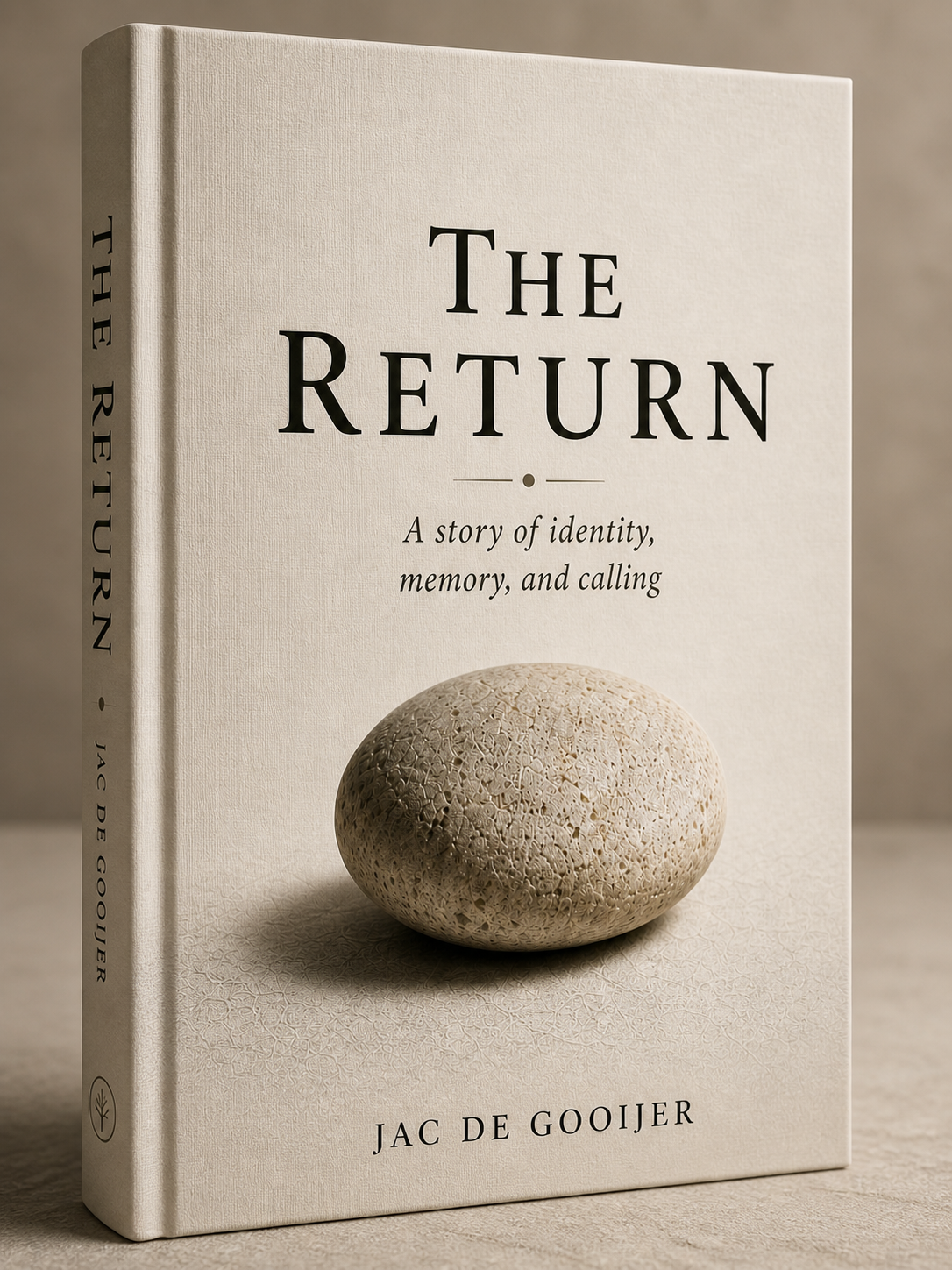
The Return is a reflective literary novel about identity, memory, loss, and calling, a story of confronting the past and rediscovering the voice within.
Some journeys lead back to the place you never truly left