
Jac de Gooijer · August 2026
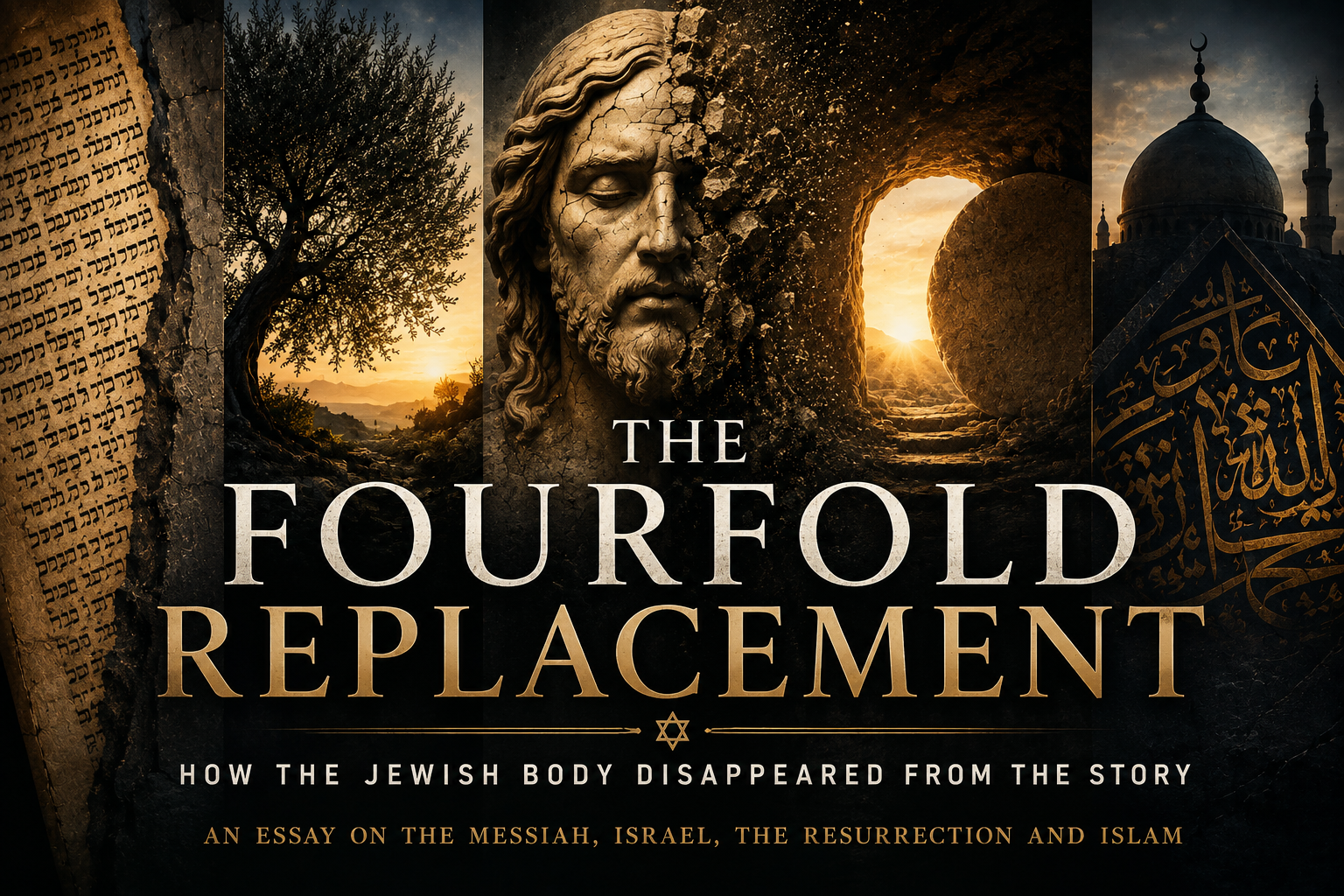
The Fourfold
Replacement.
How the Jewish Body Disappeared from the Story
Read the essay ↓ DOWNLOAD THE ESSAYReading the Bible with Jewish Eyes
“The particular, the bodily, and the covenantal.”
What happens when the concrete and Jewish character of faith is replaced by something abstract, universal, and spiritual?
An essay on the Messiah, Israel, the body, resurrection, and the four forms of replacement.
Contents
Four replacements,
one mechanism
The essay examines how the particular, bodily, and covenantal is repeatedly filtered out and replaced by the universal and spiritual.
I
The Messiah without the Covenant
The Messiah is detached from the people and covenant from which He comes.
II
The People as a Thorn in the Flesh
Israel’s continued existence is transformed from a sign of faithfulness into a theological problem.
III
The Body Replaced by the Soul
Bodily resurrection gives way to the idea of an immortal soul.
IV
Islam and Western Self-Deception
A new universal line of prophets that renders the particular covenantal line unnecessary.
The essay
The Fourfold Replacement
How the Jewish Body Disappeared from the Story
There is a pattern that repeats itself throughout two thousand years of church history, so consistently that it can no longer be called coincidence. Whenever something concrete, particular, and Jewish threatens to “burden” faith with history, physicality, and covenantal obligation, it is replaced by something abstract, universal and — let us call it what it is — Greek. This happens on three levels at once: with the Messiah, with the people of Israel, and with the resurrection itself. Whoever places these three movements side by side sees not coincidence but a mechanism.
1. The Messiah without the Covenant
The first replacement concerns the Messiah Himself. For the prophets, the Anointed One is unthinkable apart from Israel. Isaiah prophesies of a Servant who “will bring Jacob back to Him and gather Israel to Himself” (Isaiah 49:5) — the Messiah functions within and for the covenant people, not alongside it. Jeremiah’s new covenant is explicitly “with the house of Israel and the house of Judah” (Jeremiah 31:31), not a replacement covenant with another people, but a renewal of the same covenant with the same people. Even Paul, the apostle to the Gentiles, writes that the Gentiles are grafted as wild branches onto Israel’s own olive tree (Romans 11:17–24) — not the other way around.
Yet in broad parts of the Church and the mosque, the Messiah has been cut loose from that covenantal context. In Christian replacement theology, He becomes the Messiah of “the new Israel,” the Church, whereby concrete, historical Israel becomes theologically superfluous. In Islam, Isa becomes a link in a chain of prophets leading toward Muhammad, detached from the covenant with Abraham, Isaac, and Jacob. Both movements make the same move: take the Messiah out of His Jewish home, and He becomes reusable for everyone’s own universal story.
2. The People as a Thorn in the Flesh
The second replacement follows logically from the first. If the Church is the “new Israel,” what function remains for the old, literal Israel? The answer of centuries of church theology was not: it simply disappears from view. The answer was more active and darker: it must continue to exist, but humiliated, as evidence of God’s rejection. The historian Jules Isaac called this l’enseignement du mépris, the teaching of contempt — a theologically constructed narrative in which the continuing, stubborn existence of the Jewish people itself became an argument.
This is precisely why Paul warns so forcefully in Romans 11: “Do not boast against the branches… you do not support the root, but the root supports you” (Romans 11:18). He already sees the danger emerging in his own time: Gentile Christians who believe they have replaced Israel rather than having been added to it. And he concludes with one of the most ignored verses in the New Testament: “the gifts and the calling of God are irrevocable” (Romans 11:29) — God’s covenant with Israel has not been withdrawn, not even now.
What Paul feared came to pass: the survival of the Jewish people was not read as a fulfillment of God’s faithfulness, but as a disruption in their own story. A living rebuttal that had to be removed — with yellow badges, ghettos, and eventually worse. Not superfluous, but a thorn in the flesh. This also explains why the bare, sovereign existence of the State of Israel today remains such an indigestible fact for certain theological currents: it is no longer a political problem; it has become a theological problem.
3. The Body Replaced by the Soul
The third replacement is less visible, but carries the same mechanism within it: the replacement of bodily resurrection by the immortal soul.
The Tanakh knows no floating soul that leaves the body as though the body were a prison. Daniel prophesies: “many of those who sleep in the dust of the earth will awake” (Daniel 12:2) — a bodily, earthly, concrete event, connected to dust and resurrection from the earth. Job cries out: “in my flesh I shall see God” (Job 19:26) — not a spirit escaping the flesh, but flesh being raised. This was precisely the Pharisaic hope, and the hope of Yeshua’s first followers: a bodily resurrection of the dead, as Paul defends before the Sanhedrin (Acts 23:6–8) against the Sadducees, who denied the resurrection.
When this Jewish hope entered the Greco-Roman world, it collided with something fundamentally different: Platonic dualism, in which the soul is the “real” and immortal part of the human being, imprisoned in an inferior, perishable body. Church Fathers such as Origen — himself deeply shaped by Greek thought — brought this worldview into theology. The effect was structurally identical to what happened with the Messiah and the people: the concrete, bodily, Jewish was replaced by something abstract and “higher.” Away from the earth, the body, matter — toward a heaven of souls without the troublesome, particular ballast of flesh and blood.
The Fourth Line: Islam and Western Self-Deception
There is a fourth line that cannot be left out of this pattern, and which today is at least as urgent as the first three: Islam.
The Qur’an recognizes Isa as a prophet, born of a virgin and performing miracles — but explicitly not as the crucified and risen Messiah of Israel (Surah 4:157–158). More important for this argument: Islam does not present itself as a continuation of the covenant with Abraham, Isaac, and Jacob, but as a correction of it. The term tahrif — the doctrine that the Torah and Gospel have been “corrupted” by Jews and Christians — strips the Jewish covenant of its authority. Where Christian replacement theology replaces the people of Israel with the Church, Islam replaces the entire chain of revelation: Israel is not the wrong people; the text itself has become suspect. Isa becomes, as in Christian replacement thinking, a link detached from the specific covenant with a specific people — here embedded in a line of prophets culminating in Muhammad and the ummah, a universal community of faith that renders the particular, ethnic covenantal bond with Israel superfluous.
It is the same movement as with the Messiah-without-a-people and the soul-without-a-body: the particular is exchanged for the universal, and with it the covenantal, historical bond with a specific people in a specific land disappears.
What gives this extra weight is the way the West deals with it. There is a widespread conviction that the West has “nothing to fear” from Islam — that concerns about it are exaggerated, xenophobic, or outdated. The same conviction was expressed for centuries about replacement theology: it was not seen as a threat to Jews, but as pious, harmless theology. In hindsight, it proved to be the theological climate in which hatred of Jews could be ecclesiastically legitimized. The point is not that every Muslim or every believer draws the consequences — just as not every replacement theologian was personally an antisemite. The point is that a theological system that structurally marginalizes the Jewish covenant, people, and land creates a breeding ground that, under the right political circumstances, can turn against that same people. That is precisely what AIVD reports on Hamas networks in the Netherlands and the resurgence of openly expressed antisemitism after October 7 show: not an incident, but the unfolding of something that had already been theologically prepared for much longer.
Whoever says, “we have nothing to fear here,” therefore underestimates more than a political threat. Unconsciously, he repeats exactly the reassurance the West told itself for centuries about its own replacement theology — until that reassurance was refuted in blood.
The Correspondence: The Same Mechanism, Four Times
Place the four replacements side by side, and it becomes clear that they do not merely resemble one another superficially, but follow the same threefold mechanism.
First, filtering out the particular. Again and again, something concrete — a specific people, a specific body, a specific covenantal line — is exchanged for something general. The Messiah of Israel becomes the Messiah of “everyone.” The people of Israel become the “spiritual” Church. The resurrected body becomes the immortal soul. The Abraham–Isaac–Jacob covenantal line becomes a universal chain of prophets. Each time, the difficult, historical and particular disappears in favor of something that can be used everywhere and for everyone.
Then turning what has been filtered out into a problem. What is filtered out rarely disappears quietly — it becomes troublesome once it refuses to be filtered out. Replacement theology did not make the continued existence of the Jewish people a neutral remainder, but a living rebuttal that had to be explained (hence the humiliation, the ghettos). Tahrif does not make the surviving Torah and Gospel texts neutral documents, but a “corrupted” source against which one must defend oneself. In both cases, the particular that refuses to disappear is actively turned into an adversary.
Finally, presenting it as progress. None of these replacements was ever sold as loss. Replacement theology was for centuries “fulfillment,” not rejection. Platonic thinking about the soul was “deepening,” not narrowing. And today, in Western eyes, Islam is sold as a continuation and enrichment of the Abrahamic line — “we worship the same God, after all” — rather than as a system that theologically declares that same particular covenantal line superfluous. Precisely this is presented in the interfaith narrative as progress, as the ultimate solution to religious tension.
These three steps — filtering out, turning into a problem, selling as progress — together form the core of what happens in all four cases. It is no coincidence that every replacement ultimately touches the same people, the same land, and the same particular promise. That is not coincidence; that is the point of leverage.
One Movement, Four Forms
These four replacements are not separate developments that happen to exist alongside one another. It is one and the same movement, carried out four times:
The Messiah is detached from the covenant people from whom He comes.
The people themselves, when they refuse to disappear, are transformed from superfluous into threatening.
The bodily, earthly hope of resurrection is replaced by a spiritual, Greek immortality of the soul.
The entire chain of revelation is replaced in Islam by a new, universal line of prophets that renders the particular covenant with Israel superfluous.
Always the same filter: the particular, bodily, covenantal is removed in favor of the universal and spiritual. And each time this is presented as progress, as deepening, as something that makes faith more accessible to the world.
But a Messiah without a covenant people is a different Messiah from the one of the Tanakh. An Israel that serves only as a theological warning is no longer the Israel of the promise. And a resurrection that concerns only the soul is not the resurrection confessed by Daniel, Job, and Yeshua’s first disciples.
Whoever reads the Bible with Jewish eyes sees that these three things — Messiah, people, body — are not separate components that can be traded independently. They are one whole, carried by one and the same God who remains faithful to what He has promised: to a people, in a body, through an Anointed One who Himself came from that people and was bodily raised from the dead.
Not available separately. Never was.
Not available separately.
Never was.
Jac de Gooijer
jacdegooijer.comReading the Bible with Jewish eyes is not another interpretation. It is a confrontation.
Shalom 🙏✡️